AI Isn't Killing Google. It's Changing How Customers Search.

What automotive retailers need to know about AI Overviews, zero-click search, ChatGPT and the next evolution of digital visibility
For years, automotive digital marketing followed a familiar path: a consumer searched Google, clicked a result and landed on a dealership website. Artificial intelligence is changing that journey. The important point for dealers is that consumers are not simply abandoning Google for AI. Google itself is becoming an AI-powered answer engine, while tools such as ChatGPT are creating an additional discovery channel.
That means the opportunity is not to choose between Google and AI. It is to make sure your dealership remains visible wherever the customer asks the question.
Google Search Is Still Enormous — But Fewer Searches Produce a Click
Google says it handles more than 5 trillion searches annually, and the company has reported record search activity even as AI adoption accelerates. At the same time, the search experience is changing dramatically. Recent industry estimates place U.S. zero-click Google searches at roughly 65%–68%, meaning approximately two out of every three searches may end without a visit to an outside website.
For dealerships, this distinction matters. The risk is not necessarily that a shopper stops using Google. The risk is that Google answers more of the shopper's question before that person ever reaches the dealer's website.
AI Overviews Are Becoming Part of Mainstream Search
Google reports that AI Overviews reach more than 2.5 billion monthly users, while AI Mode has surpassed 1 billion monthly users. Google also says AI features are encouraging people to ask longer, more complex questions.
A traditional automotive search might be: "Honda dealer Orlando." An AI-era search can look more like: "What is the best three-row SUV under $50,000 for a family of four that gets good gas mileage, has strong resale value and is available near Orlando?"
That is a major change in consumer behavior. Dealers now need visibility not only for traditional keywords, but also inside the answers generated from these detailed shopping questions.
Organic Click-Through Rates Are Under Pressure
Independent studies consistently show that AI-generated answers can reduce traditional organic clicks. Seer Interactive's 2026 analysis found organic click-through rates of approximately 2.4% when an AI Overview was present versus 3.8% without one.
Paid search has demonstrated greater resilience, although it is not immune to the impact of AI Overviews. In the same dataset, paid CTR was approximately 16.2% on searches with an AI Overview versus 21.8% without one. The data also suggested an important connection between AI visibility and paid performance: brands cited in AI answers showed stronger paid click-through rates.
AI-powered search can introduce a dealership much earlier in the buying journey, while shoppers compare models, evaluate features and narrow their options. Paid search remains essential further down the funnel, when those same consumers begin looking for specific vehicles and purchase opportunities.
The takeaway for dealers: AI-powered discovery can introduce a dealership during research and consideration, while PPC remains critical for high-intent transactional searches such as inventory, pricing, lease offers and “dealer near me” queries. Both have an important role in the customer journey.
ChatGPT Is Becoming a Meaningful Referral Channel
AI referral traffic is still much smaller than Google traffic, but its growth — and its quality — are becoming difficult to ignore. Adobe reported that AI-driven traffic to U.S. retail sites in July 2026 was up 62% year over year and more than 1,200% compared with October 2024. Adobe also found that AI-referred retail visitors converted at a higher rate, spent more time on sites and bounced less frequently than other traffic.
That makes intuitive sense in automotive. A shopper who has already used AI to compare vehicles, features, ownership costs and local availability may arrive on a dealer website much further along in the purchase process.
SEO Isn't Going Away. It's Expanding Into AEO and GEO.
Traditional SEO focuses on earning visibility in search-engine results. AEO (Answer Engine Optimization) and GEO (Generative Engine Optimization) expand that goal: helping a dealership, its inventory and its expertise become sources that AI systems can understand, trust, cite and recommend.
For automotive retailers, this means building digital authority around the questions consumers actually ask: vehicle comparisons, price ranges, incentives, financing, ownership questions, local inventory, service expertise, reviews and why a shopper should choose one dealership over another.
A dealership does not always need to rank in the top 10 traditional organic results to earn visibility within an AI-generated answer. Research summarized in the accompanying graphic suggests AI Overviews can cite sources beyond the first page of organic results, creating additional opportunities for relevant, authoritative content.
Figure: Countering Market Pressure With SEO. Research-oriented questions show much greater AI Overview prevalence than transactional searches. Graphic supplied by Christian Coomer for dealer presentation.
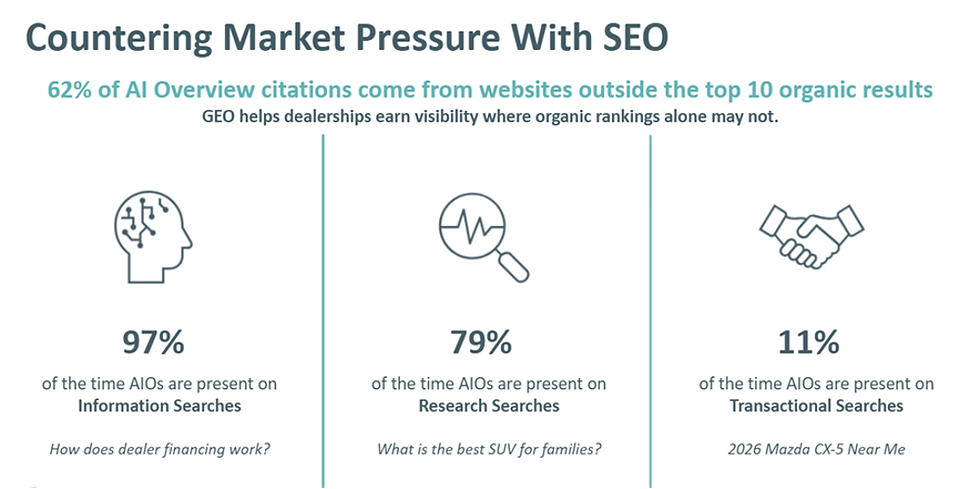
The slide reports AI Overviews on 97% of informational searches, 79% of research searches and 11% of transactional searches, and states that 62% of AI Overview citations come from websites outside the top 10 organic results. These findings reinforce a balanced approach: build early-stage visibility through useful content and SEO, AEO and GEO, while continuing to capture purchase intent through PPC.
What Dealers Should Be Doing Now
• Measure AI visibility. Track whether the dealership appears in Google AI experiences, ChatGPT and other major AI platforms for important local automotive questions.
• Create original, answer-focused content. Build useful comparison pages, FAQs, model guidance, ownership content and local buying information that directly addresses shopper questions. But prioritize quality over quantity. Generic, repetitive AI-generated articles offer little differentiation. Dealerships should publish unique, well-written content grounded in their own inventory, local market and firsthand expertise. One genuinely useful, authoritative article can offer more lasting value than five generic or duplicated pieces.
• Strengthen structured dealership data. Keep inventory, pricing, hours, location, service information and other dealership data accurate and machine-readable.
• Build authority beyond the dealership website. Reviews, trusted third-party references, local relevance and consistent brand information can all contribute to how AI systems understand a business.
• Track AI referral traffic and leads. Separate traffic from ChatGPT and other AI assistants in analytics so its contribution can be measured over time.
• Keep paid search strong. AI has not eliminated high-intent Google searches. PPC remains one of the most direct ways to reach consumers actively shopping for vehicles and dealerships. AI discovery may introduce shoppers earlier; paid search helps capture transactional intent.
The New Goal: Be the Answer, Not Just a Search Result
Google is not disappearing. Search advertising is not disappearing. SEO is not disappearing. But the consumer journey is changing quickly.
A dealership's digital strategy now has to answer two questions: Can customers find us when they search? And can AI find, understand and recommend us when customers ask?
“The objective used to be getting a dealership onto page one. The next objective is making sure the dealership is part of the answer.”
At JDA, we believe AI search visibility should be treated as an extension of a dealer’s existing search strategy, not as a replacement for it. Success requires coordinated SEO, AEO, GEO, original authoritative content and paid search. The dealerships that begin measuring and optimizing for this behavior now will have a much clearer picture of how consumers are discovering them as search continues to evolve.
Sources & Data Notes
• Google / Alphabet public disclosures and Search product updates (2026): search volume, AI Overviews and AI Mode adoption.
• Seer Interactive, 2026 AI Overview CTR studies: organic and paid click-through behavior.
• Adobe Digital Insights, 2026 retail traffic analysis: AI referral growth and engagement/conversion behavior.
• Industry zero-click research, 2026. Estimates vary by methodology; the 65%–68% range is presented as an approximate U.S. benchmark.
• Christian Coomer dealer presentation graphic, “Countering Market Pressure With SEO”: 62% citation share outside the top 10 organic results; 97% informational, 79% research and 11% transactional AI Overview prevalence. Verify underlying study dates, sample and methodology before public release.
• Editorial data check: the 65%–68% U.S. zero-click range is methodology-dependent; confirm the underlying benchmark and source before publication.
JDA | Automotive Advertising & Digital Marketing


Comments